
Second-hand Clothing Reshapes Fashion Choices Among Young Gambian
By Marian Jatta
Second-hand clothing is becoming an increasingly popular choice among young Gambians, with many turning to used garments because they are affordable, varied and flexible to keep up with changing fashion trends.
For many young shoppers, affordability and variety are among the main attractions. The market offers a wide range of dresses, trousers, shirts, jackets and other clothing at prices much more affordable than new clothes.
A young Gambian, Mariama Jallow, regularly buys second-hand clothing. Affordability and variety are among the main reasons she prefers used clothes. “Second-hand clothes are affordable, and I can find different styles that I like without spending too much money,” Mariama said.
A 23-year-old university student resident in Kanifing, Lamin Darboe, too, frequently visits the market. For him, the thrift market helps him manage his expenses while staying fashionable. “As a student, I cannot afford to buy new clothes all the time. With second-hand, I can get quality shirts and jeans for school and still look good at a low cost,” he said.
From Serekunda, Awa Ceesay, 21, prefers second-hand clothing because of their unique styles. “I like to create my own style. With second-hand clothes, I can find unique tops and dresses that you will not see everywhere, and it saves me a lot of money,” Awa said.
The popularity of second-hand clothing is also reflected in the country’s imports. World Bank data shows that The Gambia imported about 3.9 million kilograms of worn clothing and other worn articles in 2024, valued at approximately D80 million Gambian Dalasi ( US$1.08 million ).
The trade also provides income for people involved in the selling and distributing of used clothing. Salifu K. Jaiteh & Sons Enterprises in Banjul, is an example of a business involved in the importation and distribution of second-hand clothing.
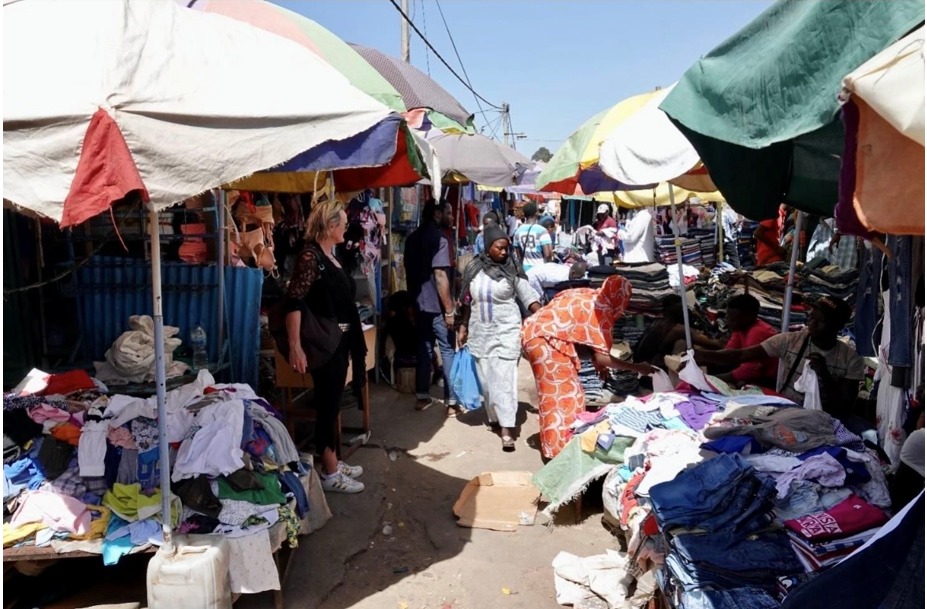
Women customers inspect second-hand clothes at the bustling Serekunda market in The Gambia
A local second-hand clothing vendor, Binta Bah, said young people are among her regular customers because of their interest in finding fashionable clothes at affordable prices. “Many young people come looking for good-quality clothes at prices they can afford,” Binta said.
However, the growing circulation of used garments also raises concerns about textile waste. While reusable clothing could extend the life of garments, unwanted clothes could eventually become waste, if they are not properly managed.
An academic researcher by Ousainou Gaye focusing on sustainable fashion systems, textile-waste management and circular-economy models in West Africa, indicated that the second-hand clothing sector has both economic and environmental implications.
For young Gambians, second-hand clothing provides an affordable way to explore fashion and express personal style; while for vendors, it provides an important source of income. However, responsible management of unwanted clothing remains important as the trade continues to grow.
Ends